

![[background image]](https://webflow-prod-assets.s3.amazonaws.com/image-generation-assets/7aec9f70-e14f-43e7-a4bf-4098f770209d.avif)



![[interface] image of blockchain security setup](https://webflow-prod-assets.s3.amazonaws.com/image-generation-assets/d2c14179-5aa8-462e-9856-7fed1e5a0e72.avif)
Ask most people why a healthcare AI project failed and they will tell you a story about the model. It wasn't accurate enough. It hallucinated. It didn't hold up at the new site. Sometimes that is true. Far more often the model was fine and never got a fair fight, because it was never actually wired into the hospital it was meant to help.
Roberto Cruz
July 21, 2026
Originally published on LinkedIn
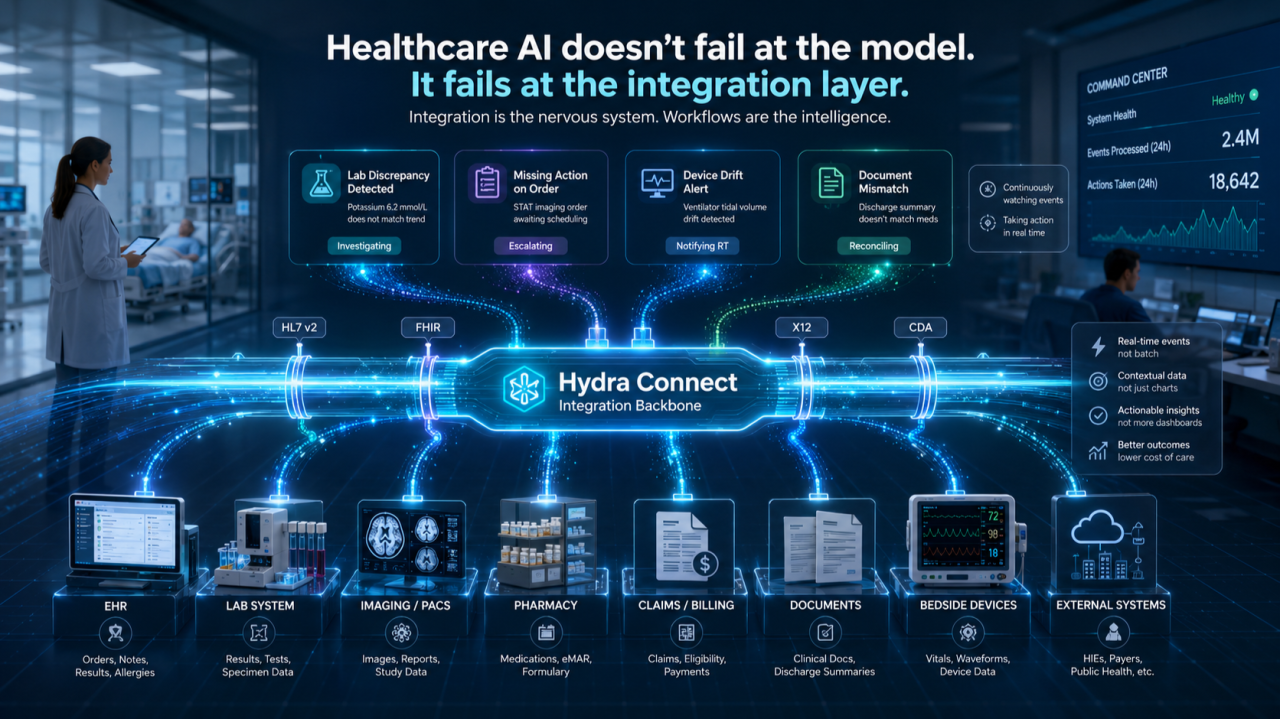
The demo ran on exported data. The pilot ran on a clean sample someone prepared by hand. And then the system that was supposed to run every day, on live records, across the places where the work actually lives, quietly never shipped.
That failure has an address, and it isn't the model. It's the integration layer. This is the argument I have made for years, and the reason we built Hydra the way we did. Clinical AI does not fail at the model. It fails underneath it, at the data.
The integration tax
A hospital is not one system. It's dozens, and almost none of them were designed to talk to each other. The EHR speaks one dialect, the lab information system another. Images move over DICOM. Claims move as X12. Documents arrive as CDA. The analyzer on the bench emits a proprietary format the vendor would rather you never touched. HL7 v2 in one interface, FHIR in the next, and every system carrying its own quiet disagreement about what a patient identifier is supposed to look like.
Every ambitious AI project in that environment hits the same wall. Before anyone can do anything intelligent, someone has to move data across those islands, reconcile it, keep it current, and keep it flowing when one of the islands changes shape. That work is the integration tax, and in healthcare it is enormous. It is where the budget goes and where the timeline slips. It is where most projects die, not in a dramatic failure but in a six-month integration effort that outlasts everyone's patience and every reason the project existed in the first place.
The uncomfortable truth is that a mediocre model on excellent plumbing will outperform a brilliant model on none. The field spent years optimizing the wrong half of the problem.
The layer that pays the tax
Hydra Connect is the part of the platform built to make that tax disappear.
It speaks the languages the hospital already speaks: HL7 v2, FHIR R4 and R5, X12, DICOM, CDA, and the custom protocols that never made it into any standard. It moves data in real time and in batch, across EHRs, PACS, labs, pharmacy and connected devices, through a library of more than fifty connectors that already know how these systems behave. What normally begins as a bespoke engineering project starts, on Hydra, as a configuration.
And it doesn't wait to be told what's out there. Connect's discovery engine can observe traffic on the hospital network, recognize FHIR, HL7 and DICOM endpoints, reconstruct their interfaces, and register them as connected sources. The map of what can be reached grows as the hospital grows, without a fresh integration project for every new device that arrives on the floor.
That is the part most integration platforms can manage on a good day. Here is the part that actually matters.
Integration that stays integrated
Most integration is built once and then slowly rots. An interface gets reconfigured over a weekend. A vendor pushes a firmware update. A schema gains a field, or loses one. The pipe that worked on Friday is quietly moving broken or stale data by Monday, and nobody notices until something downstream produces a wrong answer.
Connect is built to treat that as the normal state of the world rather than an exception. It continuously validates the integrations it depends on and watches for drift: a changed endpoint, a new schema, a contract that no longer holds. When it detects one, it heals the connection before anything acts on bad information. In a system where an agent may take a real action on what it reads, that self-correction is not a convenience. It is a safety property.
This is the difference between an integration and an integration you can trust next quarter. A connector that works today is easy. A connector that is still telling the truth after the hospital has changed around it is the entire job.
A connector is not a pipe
Here is where the argument turns, because integration on its own is dead weight. A perfectly maintained connection that moves data from one system to another, and stops there, has spent enormous effort to produce a tidier version of the same fragmentation. The data is flowing. Nothing is happening.
Integration only becomes valuable at the moment it powers a workflow. Not a dashboard someone has to remember to check, but a workflow that senses a real event, reasons about it, and does something in response. That is why we never treated Connect as a standalone product. It is the nervous system for the workflows that sit on top of it.
Those workflows live on the Hydra Agentic Platform, a no-code builder where the people who understand a process can construct the agent that runs it, without waiting on an engineering team. An agent built there doesn't read an export. It subscribes to the live event stream that every connected system publishes to, and it writes back through the same connector layer it reads from. Sensing and acting are not aspirations bolted on afterward. They are the same API calls, pointed in two directions.
Where Connect and workflows meet
Make it concrete. A result posts from a lab analyzer. On its own, that result is a message on an interface, one of thousands that day, meaningful only if the right person happens to look at the right screen at the right moment.
Wire that same interface into Connect and the result becomes an event on a shared backbone the instant it exists. A reconciliation workflow is already subscribed. It sees the new value, checks it against the order that requested it and the record it belongs to, notices that the order and the result disagree in a way that matters, and surfaces the discrepancy to a human before it propagates into a note, a code, or a bill. No one had to be watching. The workflow was watching, because the integration underneath it made the event visible the moment it happened.
Now multiply that across every interface in the building. The same pattern, the same backbone: an order that never got acted on, a device drifting out of calibration, a document that arrived without its structured counterpart, a claim built on a code the underlying record no longer supports. Each of these is invisible in a world of disconnected systems and unmissable in a world where one integration layer feeds workflows that are always watching. The connectors make the hospital legible. The workflows make it responsive. Neither half is worth much without the other, and that is the whole point.
You own all of it
Putting a layer this central at the heart of a hospital only works if the hospital keeps control of it. Hydra runs on-prem or in any cloud, with no third-party dependency. Agents run under explicitly scoped access, reaching only the systems and data they are meant to touch. The hospital owns the platform, the data, and the workflows acting on it.
Data residency is handled where it should be, at the boundary. In the United States, that means HIPAA-aligned handling of protected health information. In Europe, it means GDPR-grade treatment of health data and a design already positioned for the European Health Data Space and its 2027 requirements. When a workflow needs to span more than one site, Hydra Mesh runs each step where it is permitted to run and lets only de-identified, derived results cross a boundary, so a network of hospitals can share the intelligence of a workflow without any of them sharing a patient record.
Why this is the direction
We did not reason our way to this from a whiteboard. Hydra is deployed across flagship European hospitals, where it solved in about a week what larger vendors could not in months, and where it has been validated by strategic partners across integration, imaging and life sciences, and it will soon be available on the Epic Marketplace. The integration foundation is real, in production, and doing the unglamorous work every day.
The industry keeps looking for the breakthrough model, the one clever component that will finally make healthcare AI deliver. That was never where the problem was. The problem was always in the space between the systems, in the tax nobody wanted to pay and the connections nobody wanted to maintain. Close that gap, keep it closed, and put workflows on top that can act the moment something happens, and the intelligence you already have starts to matter.
The model was never the hard part. The integration was, and that is exactly the part we decided to own.
Roberto Cruz
CEO, TietAI — makers of Hydra, the AI infrastructure layer for healthcare.
hello@tiet.ai