




Every vendor speaks differently
Apple Health, Google Fit, Garmin, Dexcom, and other device platforms expose proprietary APIs instead of native HL7 or FHIR.
Wearables · Clinical AI · Real-time data
More than 1B wearable devices are active worldwide, but almost none of that data reaches the clinician.
Hydra turns continuous patient signals into clinical-grade, FHIR-ready data for EHRs, research, and AI agents.
1B+
wearable devices active worldwide
24/7
continuous patient data streams
FHIR R4
mapped into clinical observation resources
EHDS 2027
prepared for cross-border health data sharing
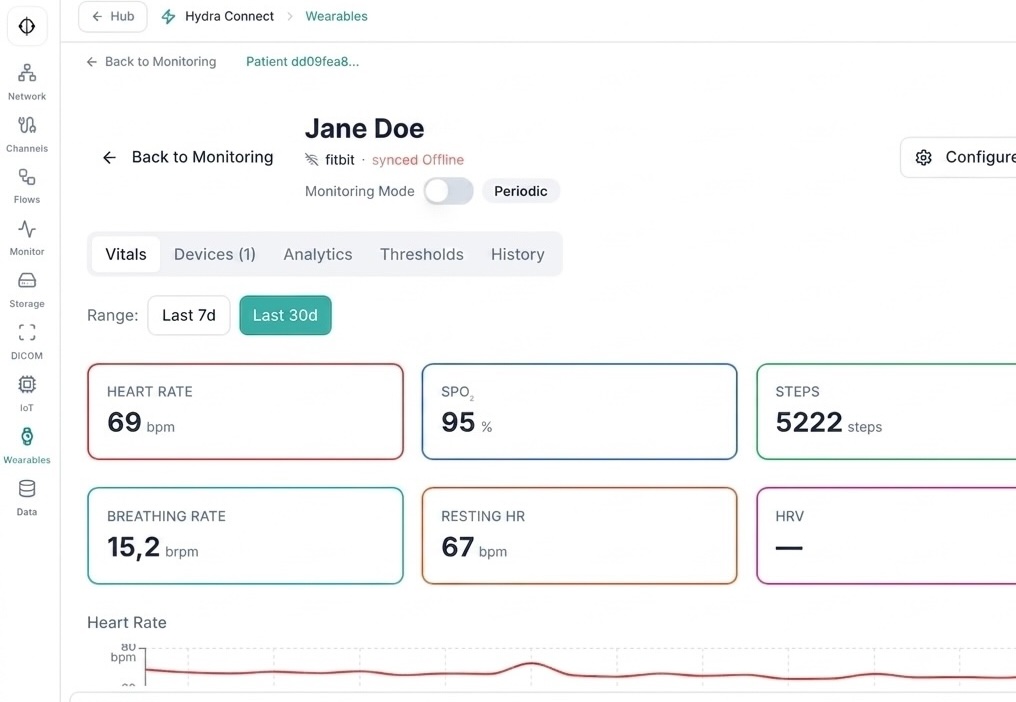
Watches, glucose monitors, smart patches, sleep trackers, and medication devices already produce heart rate, SpO2, steps, HRV, glucose trends, respiratory signals, and adherence data. The gap is getting that data into clinical systems.
Apple Health, Google Fit, Garmin, Dexcom, and other device platforms expose proprietary APIs instead of native HL7 or FHIR.
Hospital systems need FHIR Observation resources, normalized units, and clinical codes, not disconnected device JSON.
Clinical agents and decision support tools cannot act on glucose, rhythm, sleep, or mobility changes that never reach the care workflow.
Hydra Connect ingests wearable streams, normalizes device payloads, maps observations to FHIR R4, and routes clean data to EHRs, OMOP research pipelines, and AI agents.
Connect wearable, CGM, patch, tracker, and medication data sources without a custom integration per device.
Translate proprietary payloads into consistent units, clinical concepts, and FHIR Observation resources.
Send real-time data to Epic, Cerner, MEDITECH, OpenMRS, Athenahealth, OMOP, or downstream APIs.
Give clinical AI agents complete longitudinal context from continuous patient-generated data.
Continuous heart rate and HRV can reach the patient record, alerting the cardiologist before the patient calls.
CGM trends can be merged with medication history so AI can recommend dosage adjustments before the next appointment.
Sleep, activity, and respiratory data can surface deterioration days before an emergency visit.
Continuous wearable data mapped to OMOP CDM enables real-world evidence at scale without manual collection.
Wearable data is patient data under GDPR. The EU AI Act also raises the bar for data quality, traceability, and auditable clinical AI pipelines.
EHDS will require patient data, including wearable data, to be shareable across borders in standardized formats. Hydra helps make that infrastructure ready now.
The data is already there. Hydra makes it usable for care teams, EHR workflows, research, and AI.