

![[background image]](https://webflow-prod-assets.s3.amazonaws.com/image-generation-assets/7aec9f70-e14f-43e7-a4bf-4098f770209d.avif)


![[interface] image of blockchain security setup](https://webflow-prod-assets.s3.amazonaws.com/image-generation-assets/d2c14179-5aa8-462e-9856-7fed1e5a0e72.avif)
Medical research teams do not suffer from a shortage of data. They suffer from a shortage of connected data. The imaging is in the PACS. The clinical picture is in the EHR, half of it locked inside free-text discharge notes. The genomics is a VCF sitting on a lab share. The survival numbers come out of a stats package that never speaks to any of the above. The literature that puts it all in context lives in a hundred browser tabs.
Roberto Cruz
July 10, 2026
Originally published on LinkedIn
Every one of those systems is doing its job. The problem is the space between them. A research question that should take an afternoon takes a quarter, because most of the quarter is spent moving data across gaps by hand: exporting, re-identifying who's who, pasting a cohort definition into three tools that each define a cohort differently, re-deriving a number someone already derived last month, and (quietly, expensively) losing the thread of where each result actually came from.
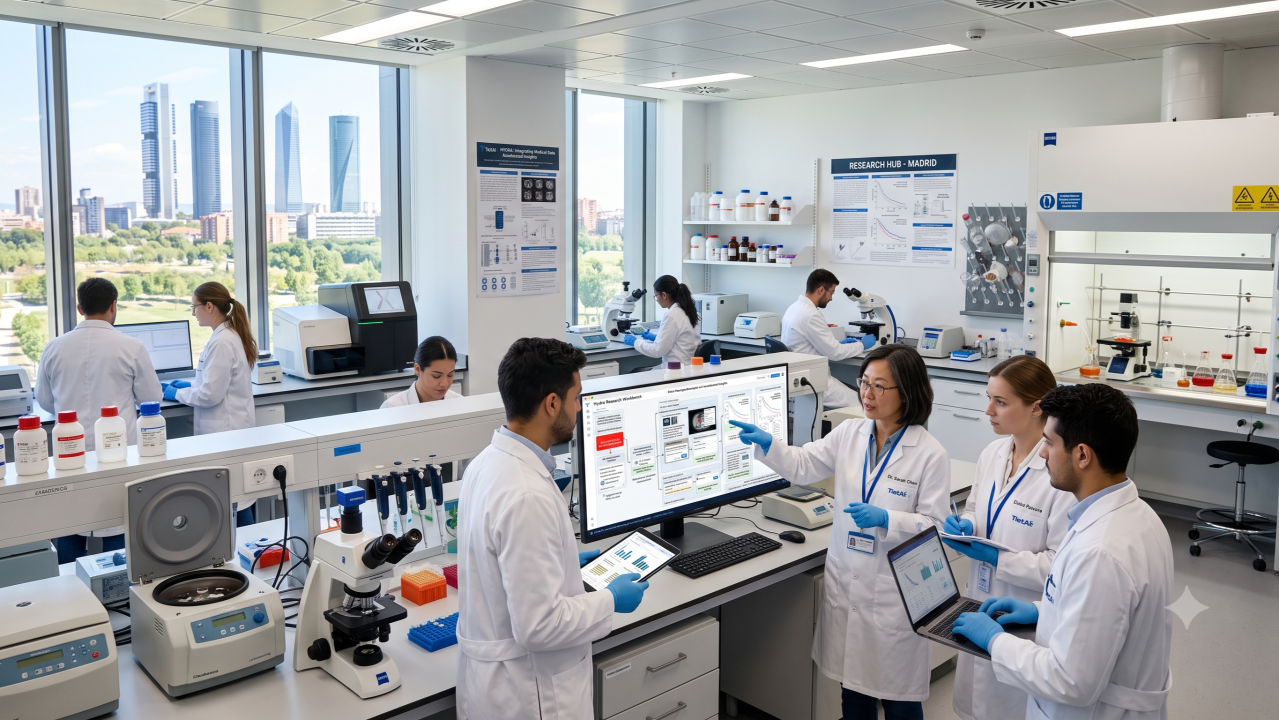
The thing that accelerates a research team isn't a faster model. It's closing the gaps. One place where the imaging, the record, the variants, the statistics and the evidence sit on the same canvas, where a result carries its own history, and where the machinery of the study (de-identification, cohort logic, annotation, sign-off) is part of the surface instead of a pile of side quests. That's what we built the Hydra research workbench to be, and the fastest way to show what it changes is to follow a single study from raw data to a finding you could defend in front of a review board.
One thread: a pancreatic cancer cohort
Take a real shape of question. Does neoadjuvant therapy change survival in resectable pancreatic ductal adenocarcinoma, and can we see the signal in our own patients before we design a trial around it?
To answer that honestly you need four kinds of data that normally live four different lives: the CT imaging, the structured clinical record, the genomic panel, and the outcomes. On Hydra, they come into one session as connected sources, an OMOP clinical database of a couple of thousand patients, a PACS pulling abdominal CT studies over DICOM, a VCF panel of a few hundred samples, and an EHR export of the discharge notes. Nothing has moved off its home system yet. They're simply in view, together, for the first time.
And immediately the first real-world problem shows up, the one every research team knows and every demo ignores: one of those sources is full of identified patient data. The discharge notes have names, MRNs, dates, the works. This is exactly the point where a lot of research velocity dies, in the ad-hoc, nervous, manually-audited scramble to scrub PHI before anyone's allowed to touch it.
De-identification as the first step, not the afterthought
So that's where the workbench starts working. The identified EHR export gets a banner that won't go away until it's dealt with, and de-identification runs as a first-class operation on the canvas, a versioned de-id pipeline that strips the PHI, tags the entities it found (patient identifiers, diagnoses, medications), and produces a clean derived block. That block is signed: it carries the identity of the pipeline, a version, and a clinician's signature attesting the step happened and passed review.
This is the first place the timeline collapses, and it's worth being precise about why. It isn't that a machine de-identified text, plenty of tools do that. It's that de-identification is now a step in the record of the study rather than a thing someone did last Tuesday in a script nobody kept. The provenance of "how do we know this is safe to use" travels with the data from the very first move. Nobody has to reconstruct it later, because it was never separate from the data in the first place.
From there the clean, structured cohort takes shape: a few hundred patients with ductal adenocarcinoma at stage II or higher, pseudonymized, signed, built once and reused everywhere downstream. Define the cohort a single time and every later step — the imaging read, the survival curve, the variant panel — points at the same definition. The version of research waste where three analyses quietly used three slightly different cohorts simply can't happen, because there's only one cohort and everything is wired to it.
Where the agents do the reading
Now the volume problem. A few hundred patients means dozens of CT studies, hundreds of slices each, that somebody has to actually read and measure. This is the kind of work that eats a research fellow's month.
On the workbench, a radiology reader agent does the first pass across the whole batch. It loads each series, segments and measures, cross-checks against the cohort's inclusion criteria, and drafts structured findings (a hypodense mass in the pancreatic head, a duct dilation measurement, a suspected vascular contact), each one tagged with a confidence score. It is not quietly deciding anything on its own. When it hits a study where the read actually matters and the confidence is only middling (a possible superior mesenteric artery contact at the threshold where the imaging protocol itself should change) it stops and asks. The finding is surfaced to a signing clinician with the specific decision spelled out, and the batch waits on a human answer before it continues.
That pause is the whole design in miniature. The agent compresses the tedious, high-volume part from weeks into an afternoon. The human spends their scarce attention only on the handful of calls that genuinely need judgment. Speed and rigor stop being a trade-off, because the agent isn't replacing the clinician's decision; it's clearing everything away from it except the decision itself.
The same pattern runs alongside for the genomics. A genomic annotator works the VCF down to the panel that matters (pathogenic variants above a variant-allele-frequency threshold) and that annotated panel is held as a locked, pending-signature input: it can't silently feed a downstream result until a human has reviewed and signed it. The annotation is fast; the accountability is explicit.
The finding, and why you can trust it
With a clean cohort, a read imaging set and a signed variant panel, the outcome analysis is almost anticlimactic, which is the point. A Kaplan-Meier survival comparison by resection status falls out of data that's already connected and already trustworthy: a hazard ratio of 0.68, a log-rank p of 0.004, a median overall survival of 14.2 months against 9.1, on 187 events across the cohort. A real signal, produced not after a quarter of data wrangling but as the natural next click once the wrangling was designed out.
And then the last mile that research usually treats as a separate project entirely: putting the finding in context. An evidence review agent assembles a brief against the external literature (the PREOPANC-2 results, a 2024 meta-analysis, the current ESMO guidance) and grades the strength of each, GRADE-style, so the internal signal is read next to what the field already knows. The brief is signed, anonymized, and sits on the same canvas as the imaging it came from.
Here is what makes the whole chain worth more than the sum of its steps. Every block carries its lineage. The evidence brief traces back to the survival analysis, which traces back to the cohort, which traces back to the de-identified export and the CT series, which trace back through the reader agent to the raw PACS pull. Click any result and you can walk upstream to the exact source it rests on, the version of the tool that produced it, and the clinician who signed it. The finding isn't a number in a slide deck that someone will ask you to re-justify in six months. It's a claim with its entire chain of custody attached.
That's not documentation you write afterward. It's a property of the system. Which means the two things a research organization actually needs from a fast result (can we reproduce it and can we defend it) are answered by construction, not by archaeology.
Why this is what accelerates a team
Step back from the thread and the acceleration isn't coming from any single clever component. It's coming from the removal of the gaps that used to sit between the components.
The team never re-integrates data between steps, because the steps share one backbone. They never re-establish trust in a result, because trust travels with it as signatures and lineage. They never redo de-identification or re-derive a cohort, because both are first-class, versioned objects built once. They spend human judgment only where judgment is required, because the agents absorb the volume and hand back the decisions. And when a study spans more than one hospital, the same guarantees hold across sites: with Hydra Mesh, each step runs where it's permitted to run and only de-identified, derived results cross a boundary, so a research network can share the finding without any site sharing a patient record.
None of this replaces the researcher. A person defines the question, answers the calls the agents escalate, and signs the results. The workbench even shows when two editors are in the inclusion-criteria notes at once, because research is a team sport and the record should reflect that. What changes is where the researcher's time goes. Less of it on plumbing, exports, re-keying and provenance reconstruction. More of it on the actual science.
The industry spent years giving research teams better tools (a better viewer, a better stats package, a better annotation model) and then left them to carry data across the gaps between those tools by hand. The gaps were always where the time went. An integrated system doesn't make any single step dramatically faster. It makes the handoffs disappear. And when the handoffs disappear, a question that used to take a quarter can be answered, with its full provenance intact, in a matter of days.
That's the research workbench Hydra is being built to become: not a faster tool in the pile, but the canvas that will make the pile into one system with the science kept human, and the machinery kept honest.
Roberto Cruz
CEO, TietAI — makers of Hydra, the AI infrastructure layer for healthcare.
Bring us your single worst data or integration problem, and we'll prove value in about a week. hello@tiet.ai